Why The Future Of Vehicle Merchandising May Depend On The Person Already Standing Beside The Car
AI-guided capture may turn the ideal operational moment into the fastest path to consistent, trusted vehicle merchandising.
For years, the automotive industry viewed vehicle photography as a specialized function.
A vehicle would move through prep, wait for a photographer, get uploaded into merchandising systems, and eventually make its way online. Entire operational processes were built around this assumption. Dedicated capture teams, outsourced vendors and centralized photography workflows became standard across dealer groups.
At the time, the logic made sense.
Creating consistent merchandising-quality imagery was difficult. Lighting changed constantly. Lots were crowded. Vehicle positioning varied. Some cars were wet, dirty or partially blocked. Most dealership employees were never trained to capture inventory with the consistency required for large-scale merchandising operations.
But artificial intelligence is beginning to challenge a much deeper assumption beneath the workflow itself.
What if the real bottleneck was never the employee?
What if the problem was the workflow?
The Most Important Capture Moment Already Exists
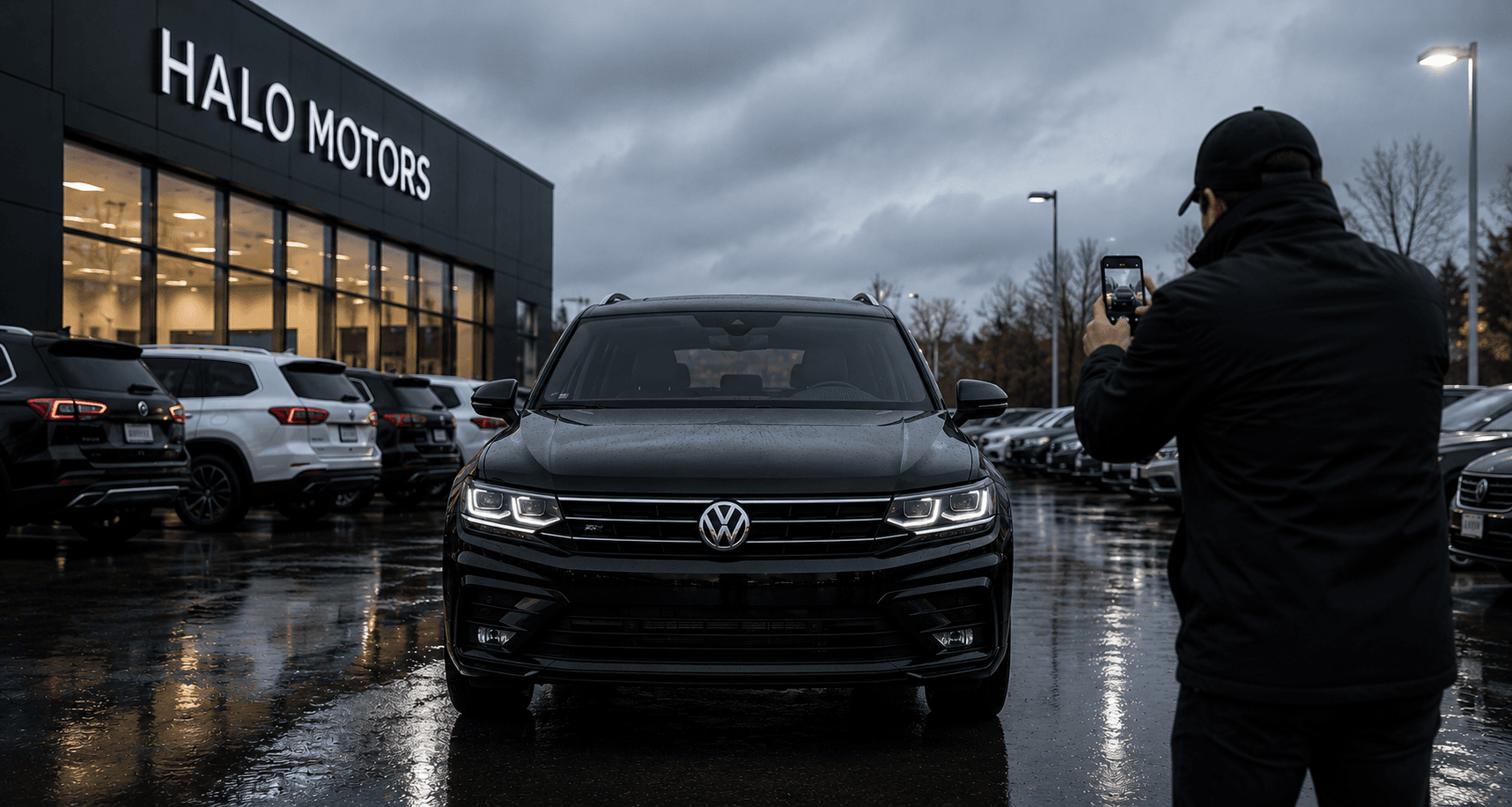
One of the more overlooked realities inside dealership operations is that the ideal moment to photograph a vehicle often already happens naturally during the operational process.
- The porter moving the vehicle across the lot.
- The recon technician completing prep.
- The salesperson receiving a trade-in.
- The lot manager staging inventory.
In many cases, someone is already standing beside the vehicle at the precise moment it is clean, operationally active and ready to move forward.
Yet traditional merchandising systems typically force that vehicle into another separate queue afterward:
- waiting for photography
- waiting for upload
- waiting for approval
- waiting to go live
Every additional handoff introduces operational latency.
For dealer groups managing thousands of vehicles across multiple rooftops, those delays compound quickly.
And in modern automotive retail, time-to-line increasingly matters.
AI Changes The Operational Equation
Historically, high-quality vehicle merchandising depended heavily on specialized human skill.
But AI-guided workflow orchestration introduces a fundamentally different possibility.
Instead of relying entirely on the experience of a photographer, intelligent systems can increasingly guide:
- positioning
- framing
- angle
- distance
- image quality
- consistency in real time
That changes the operational question entirely.
The future may no longer depend on finding enough trained photographers to scale merchandising operations.
Instead, the opportunity may lie in enabling the person already interacting with the vehicle to reliably create standardized visual evidence as part of the natural dealership workflow itself.
That distinction is significant.
Because the conversation shifts away from photography as a standalone department and toward visual capture as embedded operational infrastructure.
Why Dealer Groups Should Pay Attention
Many dealer groups are under pressure to simultaneously:
- accelerate inventory velocity
- improve merchandising consistency
- reduce operational friction
- prepare for AI-driven workflows
Yet the merchandising process itself often remains fragmented.
Vehicles move through multiple disconnected operational layers before becoming retail-ready online. Photography frequently sits as its own separate queue, requiring coordination between departments, staff schedules and vehicle availability.
That model becomes increasingly difficult to scale efficiently across large organizations.
Especially as AI systems begin depending more heavily on structured, standardized visual inputs.
The opportunity here extends well beyond creating better listing photos.
It is about operational compression.
Reducing the distance between the operational moment and the creation of trusted visual evidence.
The Next Evolution Of Merchandising
If AI-guided capture systems continue improving, vehicle merchandising may begin evolving into something much larger than a photography workflow.
Over time, visual evidence creation could become embedded directly into dealership operations themselves.
Vehicles arrive. Vehicles move through workflows. And structured visual evidence gets created continuously at the ideal operational touchpoints along the way.
Not because every employee became a professional photographer.
But because intelligent orchestration systems absorbed much of the complexity that previously required specialized human expertise.
For dealerships, the long-term implications could be substantial:
- faster time-to-line
- more consistent merchandising
- reduced operational bottlenecks
- improved cross-rooftop standardization
- stronger downstream AI infrastructure
In many ways, the automotive industry may be approaching a broader shift where visual evidence becomes one of the most important operational infrastructure layers inside the dealership.
And the organizations that learn how to operationalize capture at the right moment — instead of routing vehicles through separate legacy workflows afterward — may ultimately move faster than everyone else.